
Arthur Jafa and Richard Prince Explore America
During the Venice Biennale 2026, Ca’ Corner della Regina hosts one of the most compelling exhibitions of the season: Helter Skelter: Arthur Jafa and Richard Prince. Curated by Nancy Spector, the exhibition brings together for the first time two major figures of American contemporary art, united by a radical use of appropriation and by a shared interest in the images that have shaped, for better and for worse, the cultural imagination of the United States.
More than fifty works, including photographs, videos, paintings, sculptures, and installations, occupy the ground and first floors of Fondazione Prada’s Venetian venue, creating a portrait of America shaped by music, subcultures, race, violence, celebrity, desire, and popular culture.
Rather than a double retrospective, Helter Skelter is a confrontation between two very different ways of looking at the same country.
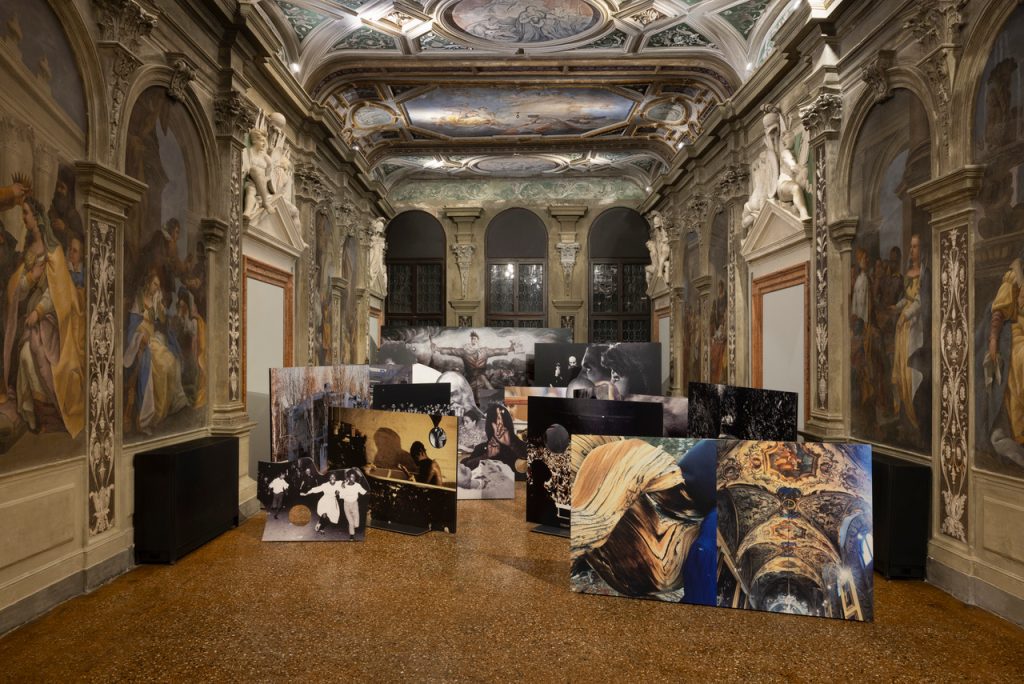
Fondazione Prada, Helter Skelter. Arthur Jafa & Richard Prince, Venice, Installation View. Photo Marco Cappelletti, courtesy Fondazione Prada
Arthur Jafa and Richard Prince: Two Artists, One Endless Archive of Images
Born in Mississippi in 1960, Arthur Jafa has developed a practice spanning cinema, photography, video, and sculpture for more than thirty years, focusing especially on Black experience and identity in the United States. In 2019, he was awarded the Golden Lion at the Venice Biennale.
Richard Prince, born in 1949 in the Panama Canal Zone and based in New York, is instead one of the leading figures of appropriation art. Since the 1970s, he has taken photographs from advertisements, magazines, and the media, reproducing and manipulating them in ways that question ideas of originality, ownership, and authorship.
What connects the two artists above all is their relationship with pre-existing images. Films, advertisements, comics, YouTube videos, record covers, science fiction, news photography, social media, and memorabilia become part of a vast archive to be collected, reworked, and recombined.
Their perspectives, however, remain very different. Jafa looks at America through Black culture, its extraordinary musical and visual production, but also through the racial violence that runs through its history. Prince, by contrast, focuses above all on the myths and contradictions of white American culture: cowboys, motorcycles, cars, celebrities, pornography, masculinity, and marginality.
Why “Helter Skelter”?
The title of the exhibition itself carries several layers of meaning. In English, helter-skelter refers to something chaotic and disorderly, but it is also the title of a famous Beatles song from 1968. Shortly after its release, Charles Manson distorted its meaning, using the expression to describe the apocalyptic race war he believed was about to take place.
The title also refers to Helter Skelter, the influential exhibition held at the Museum of Contemporary Art in Los Angeles in 1992, which notably excluded Black artists. The expression therefore becomes particularly fitting for a project that explores the contradictions of American society and the ways in which popular culture, violence, race, and representation continue to overlap.
The Exhibition: America Through Its Symbols
The exhibition begins in the courtyard of Ca’ Corner della Regina with Folk Songs (Blasting Mats) by Richard Prince, large structures made from fragments of tyres and cables normally used at demolition sites. Nearby, Big Wheel II by Arthur Jafa presents a gigantic monster-truck tyre trapped within a network of chains. Starting from the same automotive universe, the two works transform some of the most recognisable symbols of American culture — the road, speed, and individual freedom — into heavy, damaged, almost archaeological objects. This approach continues throughout the exhibition: the works are not organised simply by artist or chronologically, but are placed in dialogue through visual and thematic affinities.
The result is especially striking within the eighteenth-century interiors of Ca’ Corner della Regina. The opulence of the Venetian palace creates an almost disorienting contrast with an imagery made of tyres, bikers, advertising, violence, underground culture, and mass-media images.
Arthur Jafa: Beauty and Violence in Black Experience
One of the central works in the exhibition is Love Is The Message, The Message Is Death from 2016, one of Arthur Jafa’s best-known pieces. In just over seven minutes, the artist constructs a rapid montage of images from very different sources: sport, music, politics, protests, violence, cinema, and online footage. Accompanied by Kanye West’s Ultralight Beam, the video alternates moments of extraordinary beauty with traumatic episodes, conveying the complexity of African American experience without reducing it to a single narrative. Montage is one of the most important tools in Jafa’s practice. Images that may seem unrelated when viewed individually acquire new meaning when placed side by side.
The same principle can be found in the new work Viriconium (2026), a large-scale installation made up of cut-out figures and silhouettes drawn from history, popular culture, and the artist’s personal universe. Angela Davis, Billie Holiday, and Walt Whitman coexist with media images and references to art history, creating a kind of fragmented collective self-portrait.
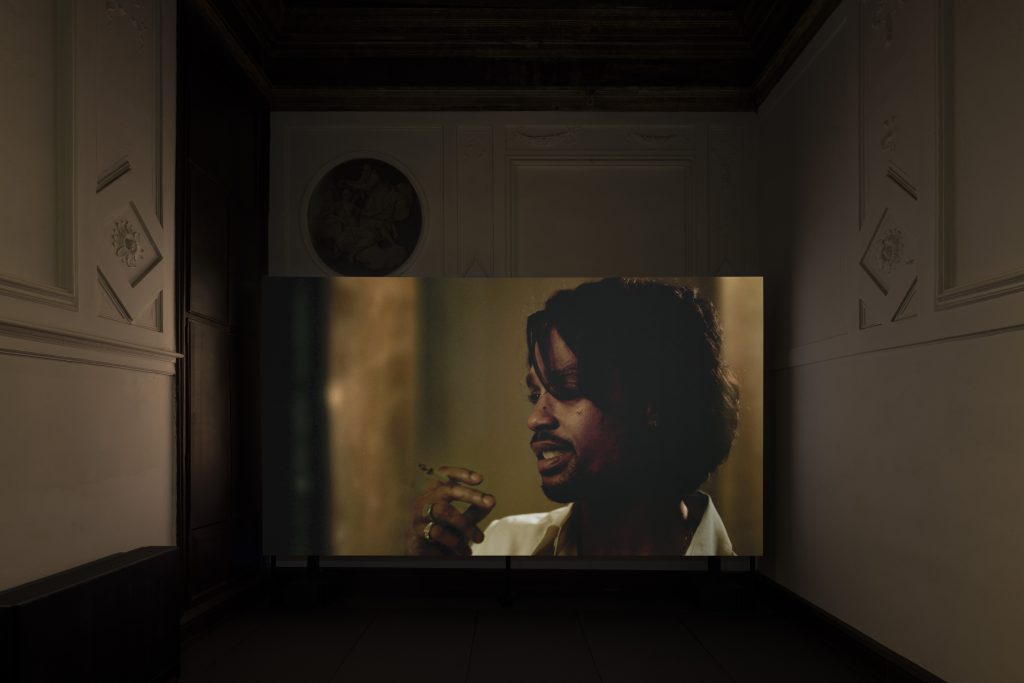
Exhibition view of Helter Skelter: Arthur Jafa and Richard Prince Photo: Andrea Rossetti Courtesy. Fondazione Prada. Arthur Jafa, BEN GAZARRA, 2024
Richard Prince and the Darker Side of the American Dream
Richard Prince’s work, by contrast, moves through some of the most deeply rooted stereotypes of the American imagination. In the series Untitled (Girlfriend), for example, the artist reuses photographs published in motorcycle magazines showing women posing beside their partners’ bikes. Removed from their original context and rephotographed, these images highlight the ambiguous relationship between desire, display, biker culture, and representations of the female body.
In The Entertainers (1982–83), Prince instead brings together promotional images of aspiring actors encountered in New York’s Times Square. Enclosed in cases reminiscent of the display windows of adult cinemas, these portraits speak about the desire for fame, but also about the often vast distance between dreams of success and reality. Cowboys, criminals, Mickey Mouse, automobiles, and entertainment figures move through the exhibition, composing an America that feels both familiar and deeply unsettling.
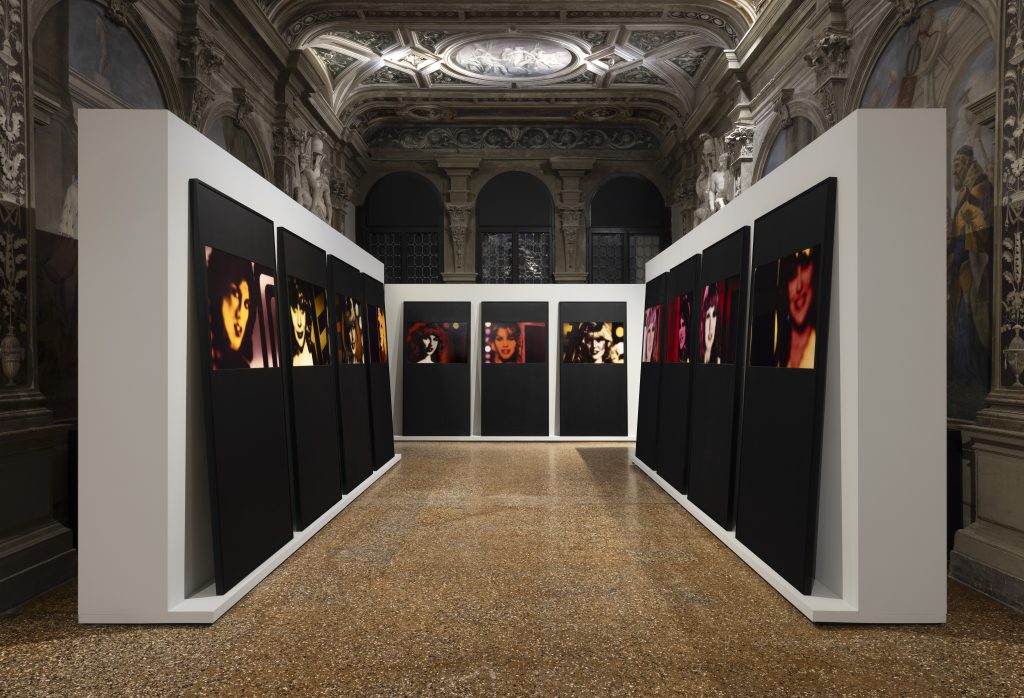
Exhibition view of Helter Skelter: Arthur Jafa and Richard Prince Photo: Andrea Rossetti Courtesy. Fondazione Prada. Richard Prince. The Entertainers, 1982-83
Two Visions of America in the Same Space
The strength of Helter Skelter lies above all in the fact that the dialogue between Jafa and Prince does not attempt to erase their differences. On the contrary, the exhibition makes use of that distance. On one side is Jafa’s perspective on Black identity, memory, and racism; on the other, Prince’s examination of white masculinity, consumer culture, and American subcultures.
Yet both artists work with the same material: the images a society produces in order to represent itself. This is perhaps the most interesting aspect of the exhibition. Advertising photographs, amateur videos, news images, or record covers are not treated as simple documents, but as elements capable of revealing deeper desires, fears, and contradictions.
Visiting Helter Skelter therefore feels like moving through an enormous visual archive of America: seductive and violent, ironic and disturbing, popular and political at the same time. It is not an exhibition that attempts to offer an ordered image of the United States. Quite the opposite: it stages its disorder.
*All images on this blog are used for educational and critical purposes only. Credits and copyrights belong to their respective owners and authors. The gallery remains at the disposal of the rightsholders for any corrections, specific citations, or immediate removals upon request.
