
Between Painting, Memory, and Contemporary Reality
At Palazzo Grassi, in the heart of Venice, painting takes centre stage with The Promise of Change, the major exhibition dedicated to Michael Armitage, one of the most compelling voices in contemporary art today. Born in Nairobi in 1984 and now working between Kenya and Indonesia, the artist creates images suspended between reality and vision, where the beauty of colour coexists with often dramatic themes: violence, political tensions, migration, inequality, and abuse of power.
On view until January 10, 2027, the exhibition brings together 45 paintings, including earlier works and new productions, as well as more than one hundred studies, offering a broad overview of Armitage’s research over the past decade. Curated by Jean-Marie Gallais, the project draws visitors into a painting practice that appears seductive at first glance, only to gradually reveal a far more complex reality.
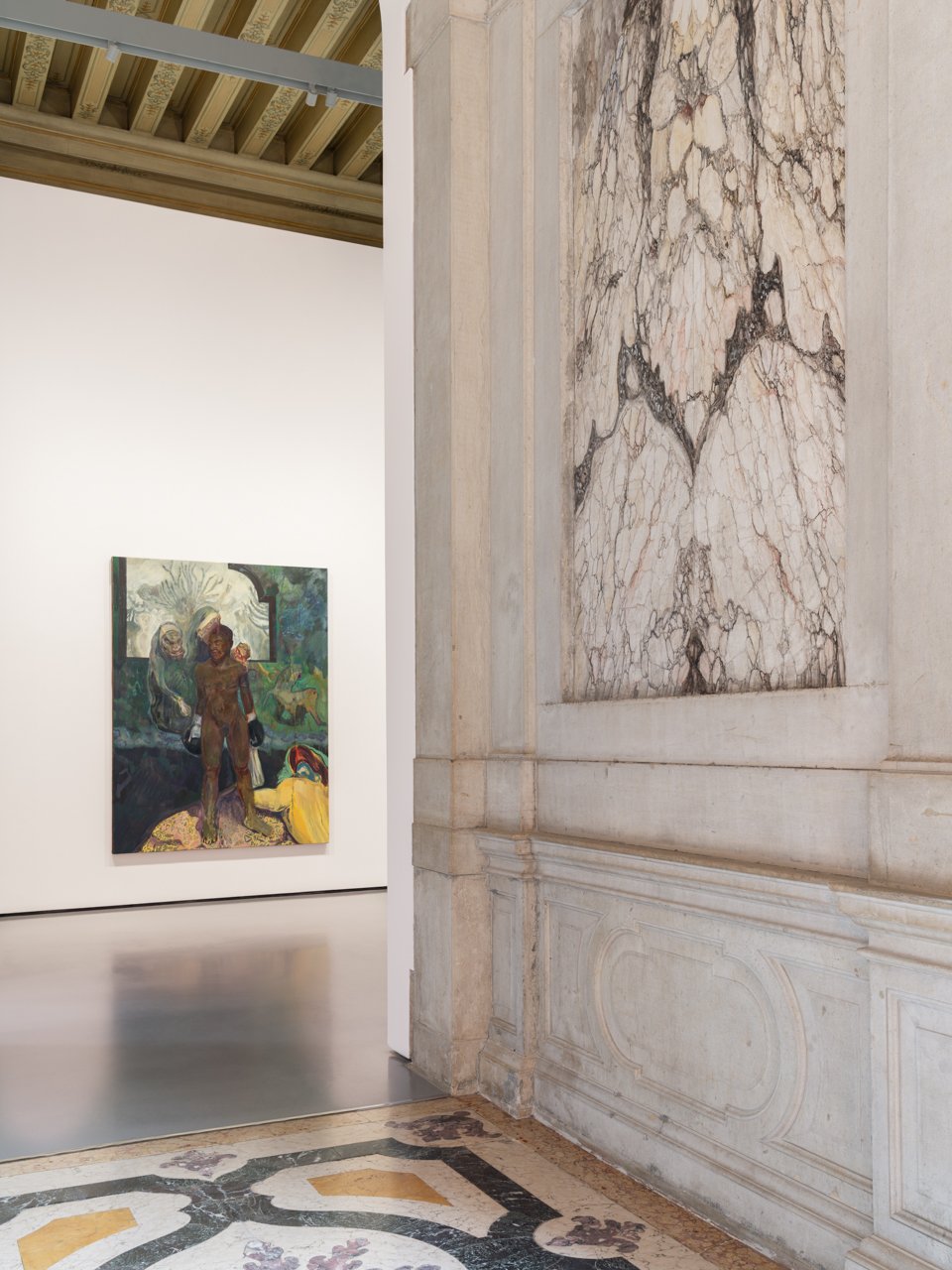
Installation views, Michael Armitage. The Promise of Change, 2026, Palazzo Grassi, Venezia. Ph. Marco Cappelletti Studio © Palazzo Grassi, Pinault Collection
Michael Armitage: From Reality to Vision
Michael Armitage’s painting often begins with the observation of real events.
Political demonstrations, violence, news stories, migration, and social transformations enter his work alongside personal memories, literature, cinema, nature, and art history. East Africa, and Kenya in particular, occupies a central place in his imagination, yet the scenes he depicts gradually move beyond the geographical contexts from which they originate.
In 2017, for example, Armitage followed a team of journalists during the protests and repression surrounding Kenya’s presidential elections. Other paintings draw inspiration from the pandemic, social inequalities, or the dangerous journeys undertaken by migrants attempting to reach Europe.
These events, however, are not transformed into simple pictorial documentation. Once they enter the painting, they merge with imaginary figures, animals, landscapes, symbols, and cultural references, becoming scenes that are difficult to place with certainty.
It is precisely this ambiguity that makes Armitage’s works so fascinating: when we look at them, we are never entirely sure of what we are seeing.
Lubugo: A Painting Practice Rooted in Material
One of the most distinctive features of Armitage’s work is the surface on which he paints.
Instead of traditional Western canvas, the artist often uses lubugo, a cloth made from the bark of the mutuba tree through an ancient process practised in Uganda. The bark is removed, beaten, and softened until it becomes a surface suitable for painting.
The material retains all of its imperfections: holes, folds, seams, tears, and variations in thickness that Armitage does not attempt to hide. On the contrary, he incorporates them directly into the composition. A tear may cross a body, a seam may interrupt a landscape, and an uneven area may alter the direction of the painting.
The surface therefore becomes an active part of the artwork.
The choice of lubugo also allows Armitage to distance himself from the traditional canvas of Western painting and to bring different artistic languages and traditions into dialogue. This is a crucial element in understanding his work: history is not only present in the images he depicts, but also embedded in the very material on which they are painted.
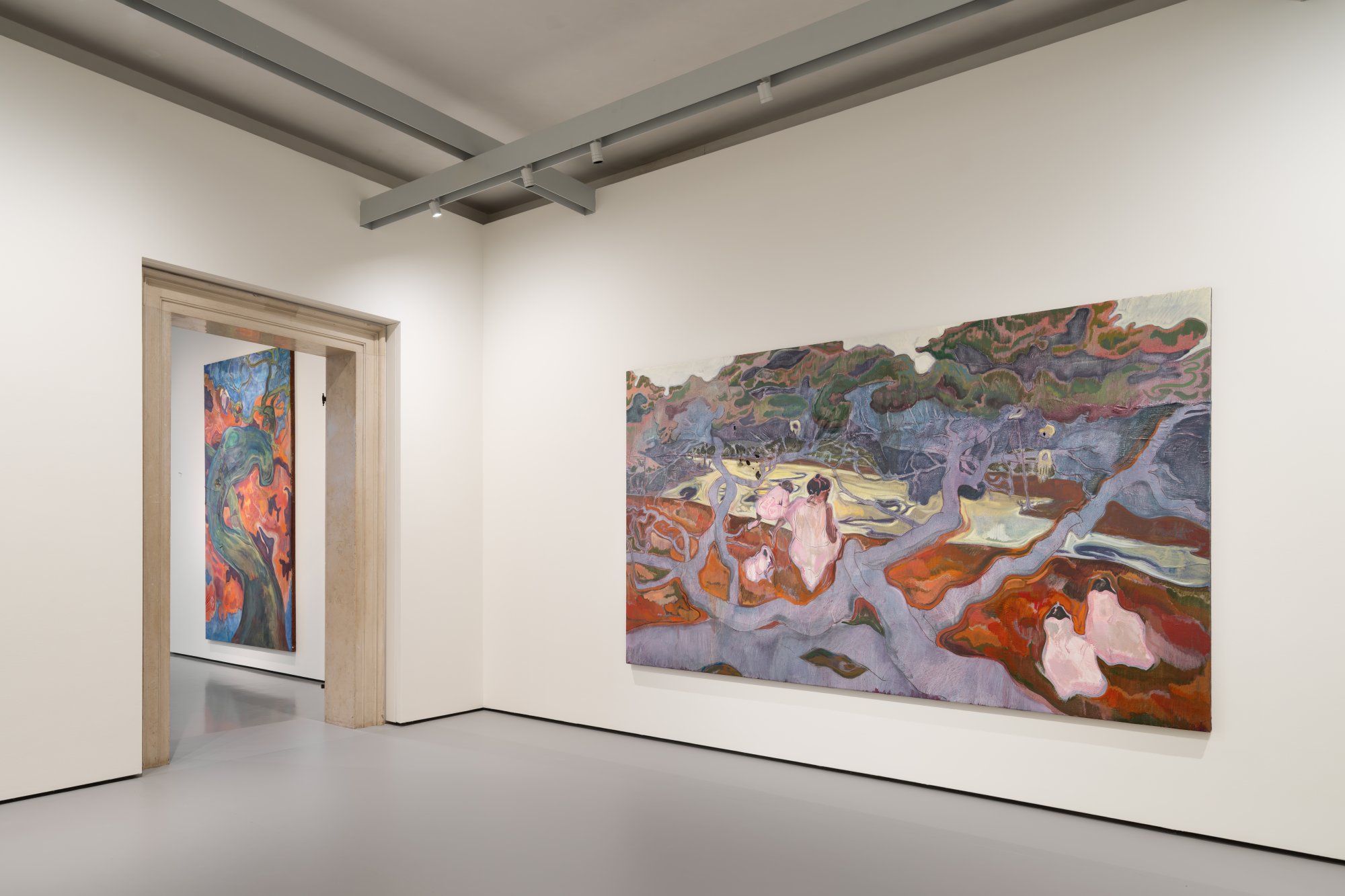
Installation views, Michael Armitage. The Promise of Change, 2026, Palazzo Grassi, Venezia. Ph. Marco Cappelletti Studio © Palazzo Grassi, Pinault Collection
Seductive Colours for Difficult Realities
The first thing that often strikes the viewer in Michael Armitage’s paintings is colour. Pinks, oranges, intense greens, reds, purples, and deep blues create highly seductive landscapes. At first glance, some paintings may even appear joyful or dreamlike. It is only by moving closer and focusing on the details that this impression begins to change.
Behind the chromatic beauty can lie episodes of political violence, prostitution, repression, discrimination, or migration. It is precisely this contradiction between what the eye initially perceives and what the painting ultimately reveals that gives his work such power.
In the paintings dedicated to migration, for example, the palette changes. The colours become colder, dominated by marine blues and nocturnal tones, while fragile human figures move through spaces that seem almost without boundaries. The sea can appear at once enveloping and threatening, a place of passage but also an element capable of erasing every certainty.
Armitage therefore does not abandon beauty in order to address difficult subjects. On the contrary, he uses its seductive power precisely to make us look longer.
Between Goya, African Cinema, and Art History
The complexity of Armitage’s work also comes from the wide range of references that inform his practice.
He looks to the history of European painting, from Francisco Goya to Théodore Géricault, Velázquez, and Gauguin, while at the same time engaging with East African artists such as Jak Katarikawe and Peter Mulindwa. Cinema and literature also play an important role: among his influences are films by Senegalese director Ousmane Sembène and the writings of Kenyan author Ngũgĩ wa Thiong’o. These references are never quoted literally.
Armitage borrows compositional structures, gestures, figures, or atmospheres and places them within a new visual language. The result is a form of painting in which different artistic traditions coexist without one fully dominating the other.
This is also why some of his large-scale compositions seem to belong to several periods at once. They can recall a historical painting or a monumental altarpiece while, at the same time, originating from a video found on social media or a news photograph.
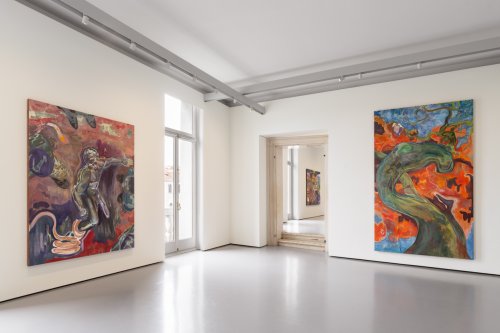
Installation views, Michael Armitage. The Promise of Change, 2026, Palazzo Grassi, Venezia. Ph. Marco Cappelletti Studio © Palazzo Grassi, Pinault Collection
The Drawings Behind the Large Paintings
Alongside the paintings, The Promise of Change gives significant space to drawing, with more than one hundred studies that offer insight into the artist’s creative process. This section of the exhibition is particularly interesting because it reveals how much the large compositions, despite their apparent freedom, arise from a continuous process of observation and construction.
Bodies, animals, faces, landscapes, and movements are studied before entering the paintings. Yet during the painting process, everything can still change: colour may cover a figure, a form may emerge from an earlier layer, and the irregular characteristics of the lubugo may suggest new directions.
The painting thus remains an open space, where figuration and abstraction continuously compete for space.
The Promise of Change: What Kind of Change Is Still Possible?
The title of the exhibition, The Promise of Change, inevitably introduces a question.
The promise of change can be political, social, or personal, but in Armitage’s works it never appears as something guaranteed. His images often explore precisely the gap between the expectations generated by politics and what actually happens to people.
Yet despite the violence and disillusionment present in many of the works, the exhibition does not convey an entirely pessimistic vision. The vitality of the colours, the constant transformation of the images, and the ability to bring different cultures and traditions into dialogue seem to suggest that painting can still be a space through which to observe the present and imagine different possibilities.
And this is perhaps what makes The Promise of Change particularly compelling. Armitage does not use painting to provide simple answers, nor does he turn the artwork into an immediate political statement. Instead, he constructs images in which reality and imagination remain in tension, leaving the viewer to navigate their multiple meanings. At Palazzo Grassi, visitors continuously move between beauty and unease, from the seduction of colour to the harshness of the stories being told.
*All images on this blog are used for educational and critical purposes only. Credits and copyrights belong to their respective owners and authors. The gallery remains at the disposal of the rightsholders for any corrections, specific citations, or immediate removals upon request.
