
Between contemporary art, language, and human connections.
From November 14, 2026 to February 14, 2027, Palazzo Contarini di San Paternian, famous for the spectacular Scala Contarini del Bovolo, hosts Le parole e le cose. 15 Years of Relationships in the Art World, an exhibition that starts from an unusual collection to explore the relationship between contemporary art, language, and human connections.
At the heart of the project is the collection built over time by CASADOROFUNGHER, the communication studio founded by Elena Casadoro Kopp and Francesca Fungher, which celebrates fifteen years of activity by presenting more than thirty works from its collection to the public for the first time.
Curated by Luca Berta, Daniele Capra, and Francesca Giubilei, the exhibition is not conceived simply as an anniversary celebration. The artworks become a starting point for reflecting on something that accompanies the art world every day but often remains behind the scenes: how is the story of an artwork constructed, and what role do relationships play in determining its circulation, understanding, and memory?
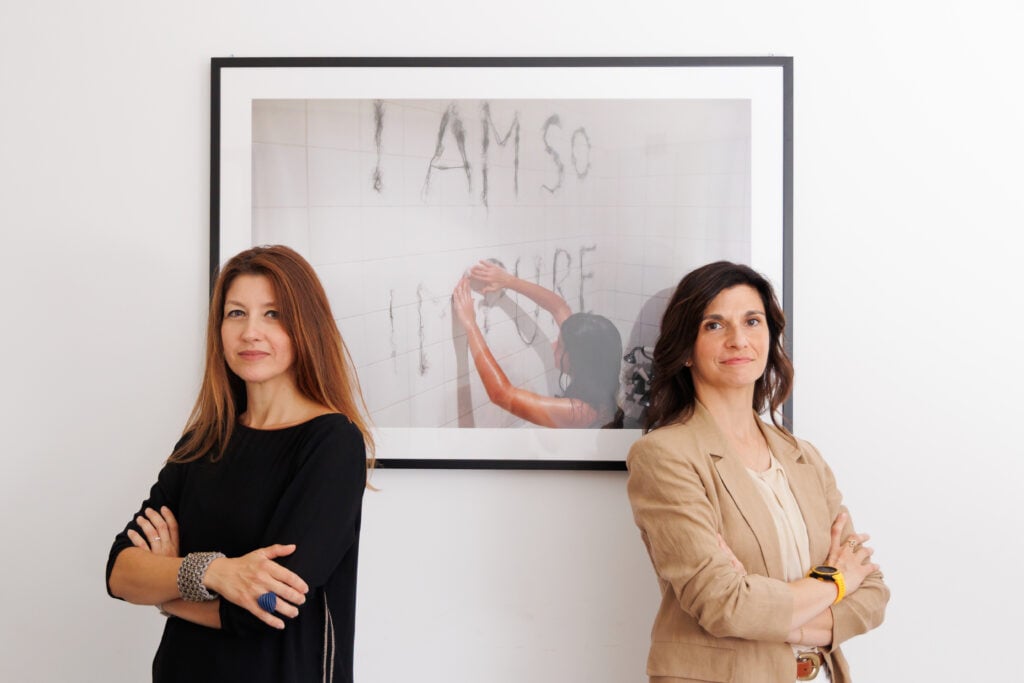
Elena Casadoro Kopp e Francesca Fungher
A Collection Built Through Fifteen Years in the Art World
CASADOROFUNGHER was founded as a studio specialising in the communication and promotion of cultural projects. Over fifteen years of activity, it has worked alongside artists, museums, foundations, and institutions, while at the same building a collection that has gradually become a kind of archive of its own professional history.
Among the artists featured in the exhibition are Giulio Alvigini, Matteo Attruia, H-E-C-K, Manuel Gualandi, Giovanni Morbin, Penzo+Fiore, Paolo Pretolani, Eleonora Rinaldi, Pierluigi Slis, and Lucia Veronesi, with works created through a wide variety of languages and techniques. In this sense, the exhibition presents a particularly interesting form of collecting. The works have not been brought together to document an artistic movement, a historical period, or a specific aesthetic trend. Rather, they bear witness to encounters and connections that have developed over time. The collection thus takes the form of a portrait: not only of the two founders and the studio itself, but also of a network of people, collaborations, and projects that indirectly reflects part of the contemporary Italian art scene.
Words and Things: From Michel Foucault to Art Communication
The title of the exhibition recalls The Order of Things, the famous book published in 1966 by French philosopher Michel Foucault, devoted to the relationships between language, representation, and the construction of knowledge. Within the context of the Venice exhibition, this reference becomes a starting point for questioning the relationship between what we see and the way we choose to describe it. This is an especially meaningful issue when speaking about contemporary art. An artwork exists first of all through its material and visual presence, but around it words are constantly being produced: critical texts, press releases, interviews, catalogues, articles, conversations, and digital content. Communicating art therefore means dealing with a delicate balance. On one hand, it is necessary to make it accessible to different audiences; on the other, there is always the risk that the need to explain may oversimplify the complexity of the work.
Le parole e le cose brings this very mechanism inside the exhibition space, transforming language from an often invisible communication tool into one of the central themes of the show.
The Tintoretto Room: When Words Enter the Artwork
The exhibition unfolds across two rooms, structured around the two elements that have accompanied the history of the studio: words and relationships. The first is the Tintoretto Room, named after the permanent presence of a preparatory sketch for Paradise, the monumental painting by Tintoretto housed in the Doge’s Palace. This room presents works in which words and language play a particularly important role. Text and image may overlap, clash, or complete one another, highlighting how a single word can alter the way we perceive what we are looking at. The presence of Tintoretto’s sketch also creates an interesting temporal short circuit. In a space deeply marked by the history of Venetian painting, contemporary works based on very different languages introduce new ways of constructing and transmitting meaning.
The result is a dialogue that spans distant periods and reminds us that the relationship between image and narrative is not exclusively a contemporary concern.
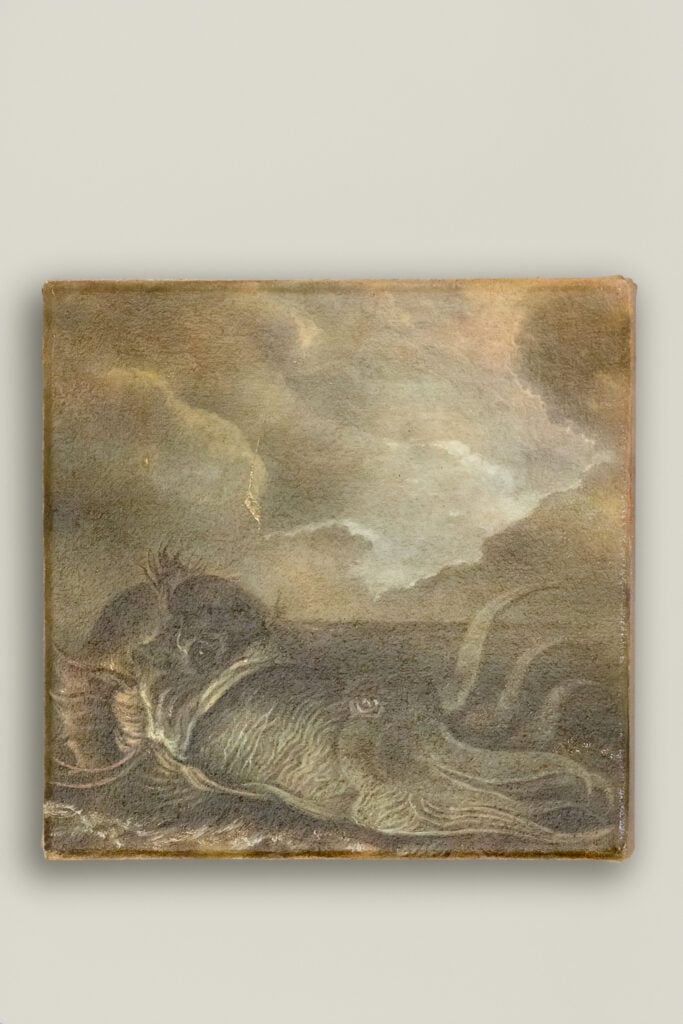
Paolo Pretolani, Untitled, oil on canvas, 2020, ph. Massimo Pistore
From Words to Relationships
The second room shifts the focus towards human relationships. Here, the exhibition becomes intentionally less linear. The works are brought together through connections, coincidences, and affinities, reflecting the element of unpredictability that characterises every relationship. And this is perhaps one of the most interesting aspects of the exhibition.
The art world is often described through artworks, artists, exhibitions, and institutions. Less attention is usually given to the network of relationships that makes many projects possible: professional encounters that become collaborations, conversations that generate new ideas, and connections built over the course of many years.
In Le parole e le cose, this usually invisible dimension becomes part of the exhibition narrative itself.
From Communication to Collection
The exhibition is also distinctive because it reverses the usual roles. Normally, a press office works behind an exhibition: it develops the communication strategy, connects artists and journalists, produces materials, and helps the project circulate beyond the space in which it is presented. Here, almost the opposite happens. The history of those who communicate art becomes the subject of an exhibition itself. The works collected over the years make it possible to consider what remains after a project has ended, beyond press releases and beyond the immediacy of news. In this transition, the collection takes on almost the role of a material memory of the professional and personal experiences accumulated over time.
This feels particularly relevant at a moment when cultural communication is increasingly fast-paced and dominated by images and content that are quickly replaced by something new. A collection follows the opposite rhythm: it preserves, accumulates layers, and allows relationships to leave a trace.
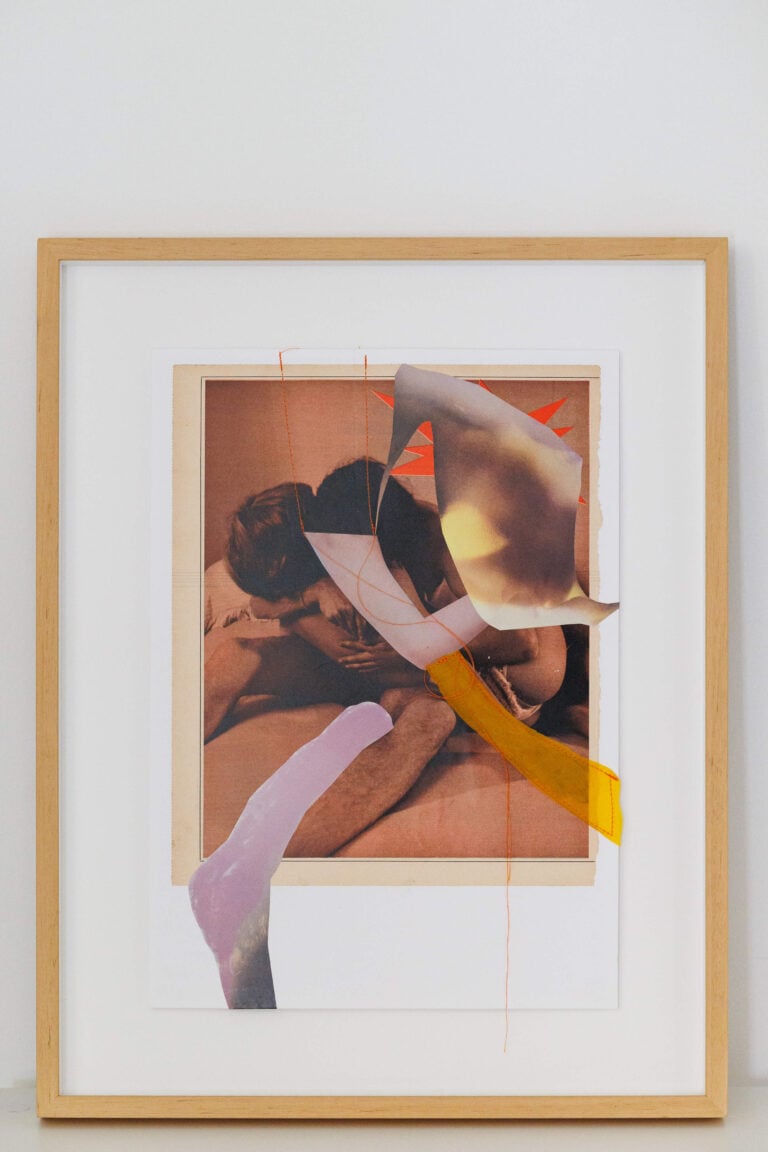
Lucia Veronesi, Cuore solitario, collage, mix media, canvass and sewing thread on paper, 2021, ph. Massimo Pistore
Venice, Words, and What Remains
The choice of Venice as the setting for the exhibition makes this reflection even more meaningful. The city is one of the main international meeting points for the art world: the Biennale, museums, foundations, galleries, and independent exhibitions constantly create new connections between artists, curators, collectors, professionals, and audiences. Within this context, Le parole e le cose chooses to tell the story of the art system from a less visible point of view: that of the relationships that develop around artworks. More than a simple celebration of CASADOROFUNGHER’s fifteen years of activity, the exhibition therefore becomes a reflection on the ways art is described, shared, and remembered. The works naturally remain at the centre, but around them words, people, and stories begin to emerge. And perhaps this is the most interesting message of the project: in the art world, the things we preserve and the words we choose to describe them inevitably end up constructing the memory of the relationships we have experienced as well.
*All images on this blog are used for educational and critical purposes only. Credits and copyrights belong to their respective owners and authors. The gallery remains at the disposal of the rightsholders for any corrections, specific citations, or immediate removals upon request.

