
From Infinity Rooms to Immersive Installations
Yayoi Kusama, one of the most recognizable and influential figures in contemporary art, has died at the age of 97. From her famous polka dots to the Infinity Mirror Rooms, the Japanese artist spent more than seventy years transforming obsessions, personal struggles and visions into artworks that have become part of our collective imagination.
It is difficult to think about contemporary art over the past few decades without encountering, sooner or later, the polka dots of Yayoi Kusama. An apparently simple motif became, in the hands of the Japanese artist, a powerful means of exploring infinity, the dissolution of the self, our relationship with the cosmos and, above all, her own complex inner world.
Yayoi Kusama died at the age of 97 on August 14; news of her death was made public on August 27. Her passing brings to a close a career spanning more than seventy years, during which the artist experimented with painting, sculpture, performance, film and large-scale environmental installations, creating one of the most instantly recognizable visual languages in 20th- and 21st-century art.
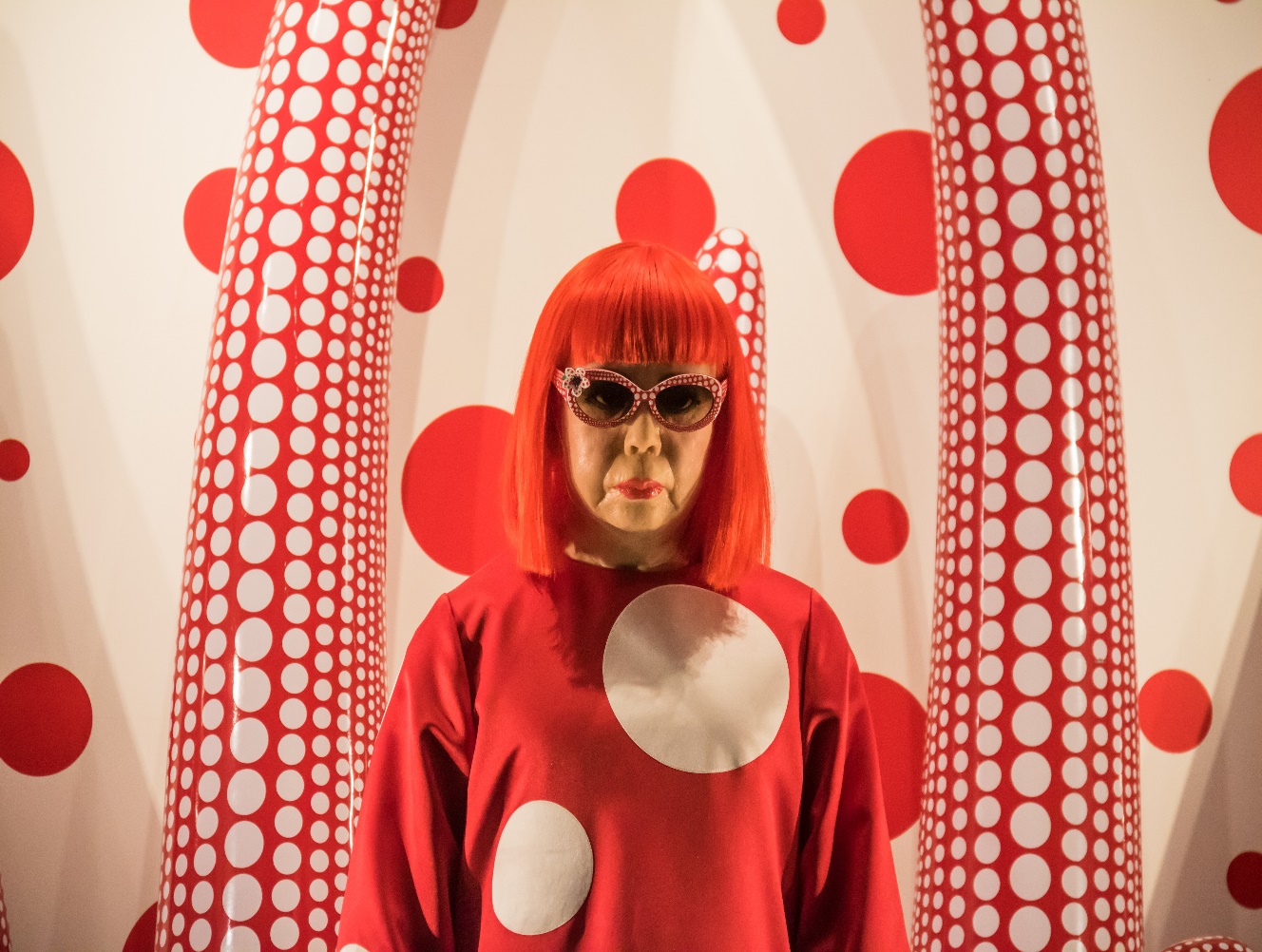
"Artwork by Yayoi Kusama” by Susanne Nilsson. Wikimedia Commons, Creative Commons Attribution-Share Alike 2.0
Yayoi Kusama: From a Difficult Childhood to Art as a Necessity
Born in 1929 in Matsumoto, in Japan’s Nagano Prefecture, Yayoi Kusama showed a strong interest in drawing from an early age. Around the age of ten, she also began experiencing the visions and hallucinations that, as she would later explain, profoundly influenced her artistic practice.
The repetition of shapes, nets and dots gradually became a way of translating onto a surface what she perceived in her mind. For Kusama, art was therefore not simply a professional choice, but a necessity from the very beginning.
Her childhood was also marked by a difficult relationship with her family. Her mother opposed her artistic ambitions and, according to Kusama’s own recollections, would take away her drawings and art materials. This complicated family environment contributed to shaping a restless personality and a creative practice characterized by the urgency of repetition.
Transforming Personal Struggles into Contemporary Art
Throughout her long career, Yayoi Kusama succeeded in transforming personal experiences, fears and obsessions into a visual universe capable of captivating an international audience.
The relationship between creativity and mental health runs through much of her work. In the late 1970s, the artist chose to live at the Seiwa Hospital in Tokyo, a psychiatric facility, while continuing to work in her nearby studio and develop new projects.
Her artistic practice thus became a way of processing and managing her inner visions. Through dots, colors, repeated surfaces and seemingly infinite environments, Kusama created a language in which spectacle coexists with much more intimate themes: fear, loneliness, death, the dissolution of identity and the desire to become part of something universal.
Until the final years of her life, her artworks continued to be exhibited in major museums and international exhibitions. In Italy, between 2023 and 2024, the exhibition Infinito Presente at Palazzo della Ragione in Bergamo brought Fireflies on the Water to the country for the first time. One of Kusama’s most celebrated Infinity Mirror Rooms, the work came from the Whitney Museum of American Art in New York.
Yayoi Kusama in New York: Encountering the American Avant-Garde
A decisive moment in Yayoi Kusama’s career came in the late 1950s, when she left Japan and moved to New York.
At the time, the city was one of the most dynamic centers of international artistic experimentation. These were the years of Abstract Expressionism, new avant-garde movements and, shortly afterwards, the rise of Pop Art and Andy Warhol’s Factory.
Within this environment, Kusama gradually attracted critical attention, despite the difficulties she faced as a woman and an Asian artist within the American art world of the period. Her large Infinity Nets paintings were among the first works to establish her reputation: vast surfaces created through the almost obsessive repetition of the same painted gesture.
The Brata Gallery became one of the first important venues in the development of her career in New York.
The Infinity Mirror Rooms and the Birth of a Contemporary Art Icon
In 1965, Yayoi Kusama presented Infinity Mirror Room – Phalli’s Field, a work that would become a turning point in her career.
Inside a room covered with mirrors, the artist arranged a multitude of soft, tentacle-like forms covered in polka dots. The reflections multiplied the objects and surrounding space, apparently erasing the boundaries of the room and drawing the viewer into a seemingly endless environment.
This marked the beginning of the concept behind the Infinity Mirror Rooms, which Kusama would develop in numerous variations over the following decades. Long before the current popularity of immersive exhibitions, the artist had already understood the possibilities of an art capable of physically involving visitors and transforming their perception of space.
During the same period, Kusama also experimented with performances and happenings, often involving bodies covered in polka dots. Her artistic activity was closely connected to political and social engagement: while living in the United States, she spoke out against the Vietnam War and addressed issues such as sexual freedom, racial and gender discrimination and gay rights.
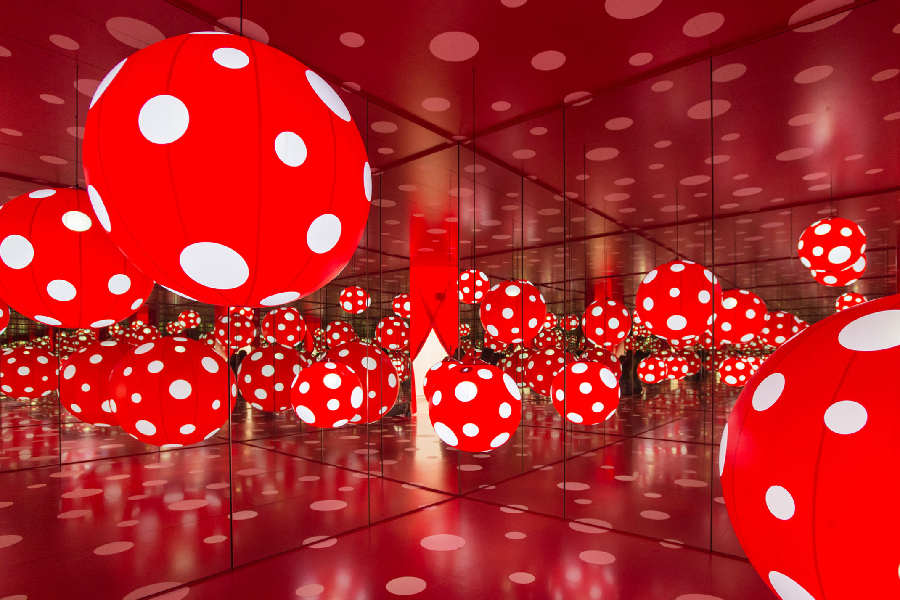
Work of Yayoi Kusama, Dots Obsession, 2013-2016. Photo M.Ahmadani. Wikimedia Commons, license CC BY-SA 4.0
Returning to Japan and International Rediscovery
In 1975, Yayoi Kusama returned to Japan. However, her homecoming did not immediately lead to recognition in her native country. For a period, the artist also devoted herself to writing while experiencing a particularly difficult phase in her mental health.
From the late 1980s onwards, however, international interest in her work began to grow again. An important milestone was the retrospective organized by the Center for International Contemporary Arts in New York in 1989.
Then, in 1993, came a decisive moment of recognition: Yayoi Kusama represented Japan at the Venice Biennale. It was also during this period that her famous pumpkins gained new prominence, eventually becoming one of the most recognizable subjects in her artistic production.
Yayoi Kusama’s Most Famous Artworks: Polka Dots, Pumpkins and Infinity
Paintings, sculptures, installations, films and performances: Kusama’s artistic production encompasses a wide variety of techniques and media while maintaining several recurring elements.
Repetition is perhaps the fundamental principle behind her artworks. Polka dots, nets, organic shapes, flowers and pumpkins are multiplied until they completely occupy a surface or space, suggesting the idea of a universe without boundaries.
Among the major themes that continually emerge throughout her work are infinity, accumulation, nature, the cosmos, death, loneliness and the energy of life.
The Infinity Mirror Rooms represent perhaps the most spectacular expression of this artistic vision. Among the best-known examples are Infinity Mirrored Room – Filled with the Brilliance of Life, presented at Tate Modern, and Fireflies on the Water from 2002, where tiny suspended lights are endlessly multiplied by water and surrounding mirrors.
In 2020, the Yayoi Kusama Museum in Tokyo also presented A Wish for Human Happiness Calling from Beyond the Universe. During the pandemic years, the artist continued her research, also working on the series Every Day I Pray for Love.
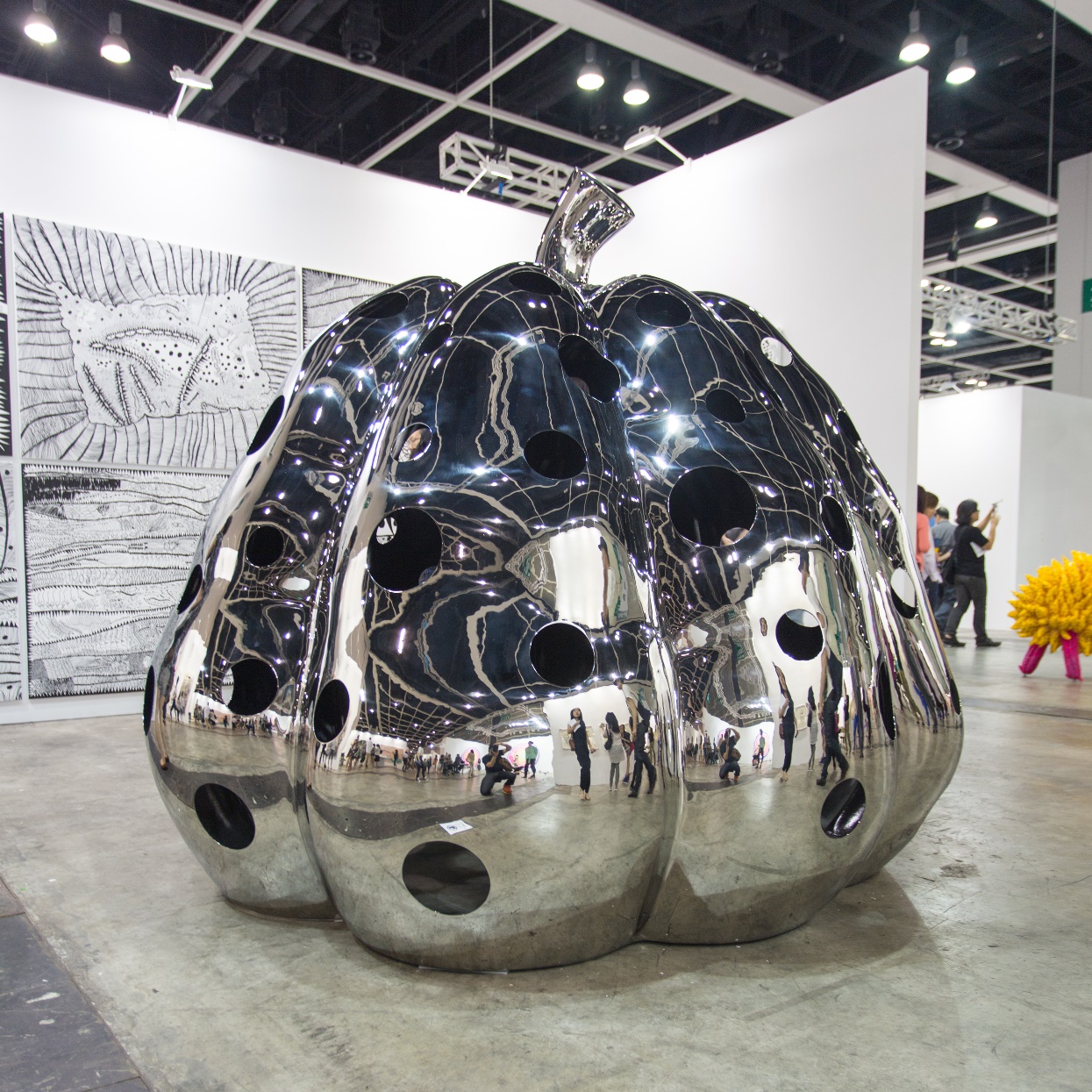
Installation by Yayoi Kusama Pumpkin, 2010 (stainless steel).
Photo See-ming Lee. Wikimedia Commons
Creative Commons Attribution-Share Alike 2.0
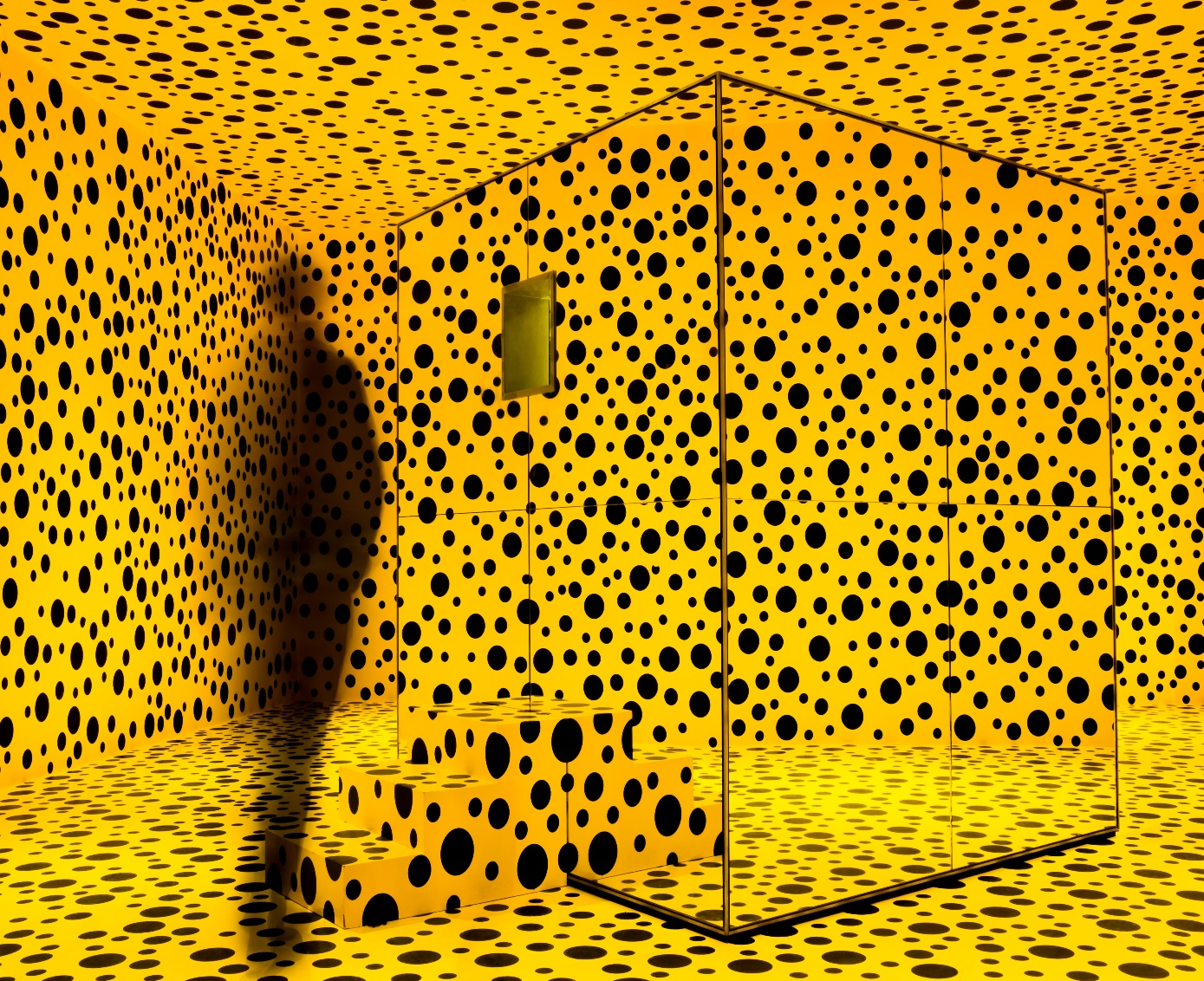
Yayoi Kusama, exhibition at Louisiana Museum of Modern Art, Denmark.
Photo Kristoffer Trolle. Wikimedia Commons license
Creative Commons Attribution-Share Alike 2.0
Yayoi Kusama in Museums and Popular Culture
Today, Yayoi Kusama’s artworks are part of the collections of some of the world’s most important museums, from the Museum of Modern Art in New York and Tate Modern in London to the National Museum of Modern Art in Tokyo.
However, the artist’s influence has long extended beyond the traditional boundaries of contemporary art.
In 1994, she collaborated with Peter Gabriel on the music video for Lovetown, while her relationship with the fashion world – and Louis Vuitton in particular – became especially significant.
Her first major collaboration with the fashion house dates back to 2012, during Marc Jacobs’ tenure as creative director, with a collection dominated by Kusama’s unmistakable polka dots. The project was relaunched on a global scale in 2023, transforming boutiques, shop windows and public spaces into large installations inspired by her visual universe.
From monumental pumpkins and façades covered in polka dots to a robotic reproduction of the artist painting inside shop windows in New York and Paris, Kusama’s aesthetic became a global phenomenon positioned at the intersection of art, fashion and popular culture.
Yayoi Kusama Beyond the Polka Dots: The Legacy of a Great Artist
The extraordinary popularity achieved by Yayoi Kusama in recent years made her one of the most recognizable artists in the world. Her red wig, polka-dot clothing, monumental pumpkins and Infinity Mirror Rooms became part of an immediately identifiable visual language, even among audiences with little familiarity with contemporary art.
Yet this enormous visibility also risks simplifying a much more complex body of work.
Behind the spectacular and highly photogenic nature of her installations lies an intensely personal exploration of obsession, fear of death, loneliness, the disappearance of the boundaries of the self and the relationship between creativity and psychological suffering.
This is perhaps one of the most fascinating aspects of Kusama’s legacy: an artistic language that emerged partly as a personal means of confronting her own fragilities ultimately became one of the most widespread, recognizable and commercialized visual languages in contemporary art.
With the death of Yayoi Kusama, one of the longest and most distinctive careers in 20th- and 21st-century art comes to an end. What remains are her artworks, her infinite spaces and the universe of dots through which the artist spent her life attempting to overcome the boundaries of the individual and transform personal experience into a universal language.
*All images on this blog are used for educational and critical purposes only. Credits and copyrights belong to their respective owners and authors. The gallery remains at the disposal of the rightsholders for any corrections, specific citations, or immediate removals upon request.

