
Two Exhibitions Reconsider History Through Contemporary Art
In the heart of Venice, Punta della Dogana hosts two major exhibitions dedicated to Lorna Simpson and Paulo Nazareth until November 22, 2026. Third Person and Algebra bring painting, photography, collage, video, and installation into dialogue to explore memory, identity, colonialism, and those parts of history that have too often been erased or told from a single point of view.
At first glance, the two artists’ practices may seem to move in different directions. Lorna Simpson creates large images dominated by shades of blue, works with photographic archives, and investigates the representation of African American identity. Paulo Nazareth physically crosses territories and borders, transforming travel, the body, and encounters into artistic material.
Yet when the two exhibitions are experienced one after the other, a common ground emerges: both artists seek to bring back to the surface stories, people, and memories that have remained at the margins of official narratives. The exhibitions, which opened on March 29 during the Venice Biennale season, occupy the spaces of the former Dogana da Mar, restored by Tadao Ando, and are part of the 2026 programme of the Pinault Collection.
Lorna Simpson. Third Person: Images, Memory, and Identity
With Third Person, curated by Emma Lavigne, Punta della Dogana presents one of the most important European exhibitions devoted to Lorna Simpson in the last decade.
Organised in partnership with The Metropolitan Museum of Art in New York, the exhibition brings together around fifty works including paintings, collages, sculptures, installations, and films, with particular focus on the evolution of the American artist’s painting practice over the last ten years.
Born in Brooklyn in 1960, Simpson emerged in the 1980s through conceptual photography, placing issues of identity, gender, and the representation of African American people at the centre of her work from the very beginning. Over the years, her practice gradually expanded into collage and painting, while maintaining her interest in pre-existing images.
Archival photographs, news imagery, and above all magazines historically aimed at African American audiences, such as Ebony and Jet, become materials to be transformed and recomposed. Images from the past are removed from their original context and acquire new meanings, challenging stereotypes and established narratives.
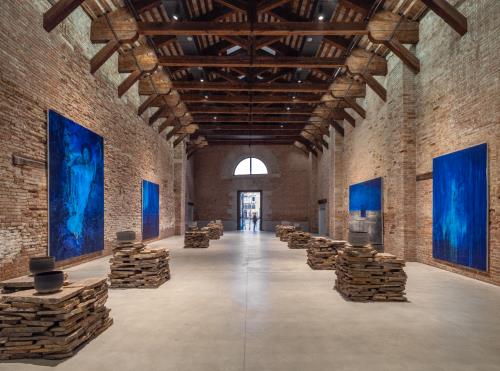
Installation views, Lorna Simpson. Third Person, 2026, Punta della Dogana, Venice. Ph. James Wang © Palazzo Grassi, Pinault Collection
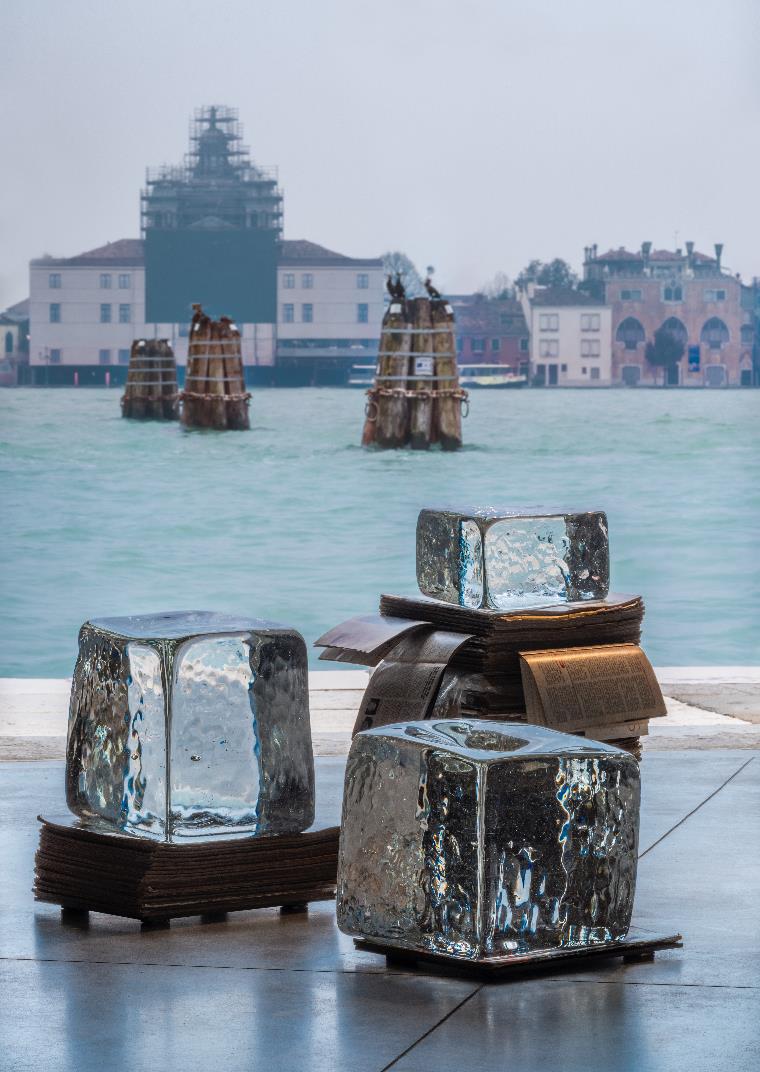
Installation views, Lorna Simpson. Third Person, 2026, Punta della Dogana, Venice. Ph. James Wang © Palazzo Grassi, Pinault Collection
Lorna Simpson’s Blue: Between Ice, Sky, and Female Figures
One of the most striking elements of the exhibition is undoubtedly the colour blue, which runs through many of Simpson’s large-scale paintings. In works from series such as Ice and Earth and Sky, icy expanses, skies, and almost abstract atmospheres become suspended landscapes. Yet behind their apparent beauty lies a reflection on history and on those who have been excluded from its narratives.
Simpson also draws on photographs connected to early twentieth-century polar expeditions, bringing renewed attention to the African American explorer Matthew Henson. Once again, the archive becomes a space to reopen and question. In the Cube designed by Tadao Ando, monumental female figures appear immersed among nebulae, stars, and fields of colour. Women are a recurring presence in Simpson’s work: faces and bodies emerge, disappear, or are partially erased, making it impossible to reduce identity to a fixed representation.
Collage is equally important. Simpson has used the technique for years to layer photographs, cut-outs, and painted forms. Around forty works gathered in the exhibition create a kind of visual archive in constant motion, where memory and imagination begin to merge.
Paulo Nazareth. Algebra: Travel as Artistic Practice
On the upper floor, the atmosphere changes with Paulo Nazareth. Algebra, curated by Fernanda Brenner. The exhibition spans more than twenty years of the Brazilian artist’s practice and includes works from the Pinault Collection alongside new pieces. Photography, video, painting, objects, and large-scale installations emerge from a practice closely connected to movement.
For Nazareth, in fact, walking is already an artistic act. The artist has undertaken long journeys on foot across the Americas, the Caribbean, and the African continent, crossing borders and encountering different communities. Travel becomes a way of observing the still-visible consequences of colonialism, forced migration, and systemic racism.
His work therefore does not separate art from life. Encounters, collected objects, photographs, and stories gathered along the way become part of a personal archive through which Nazareth draws alternative cartographies to those constructed by colonial power.
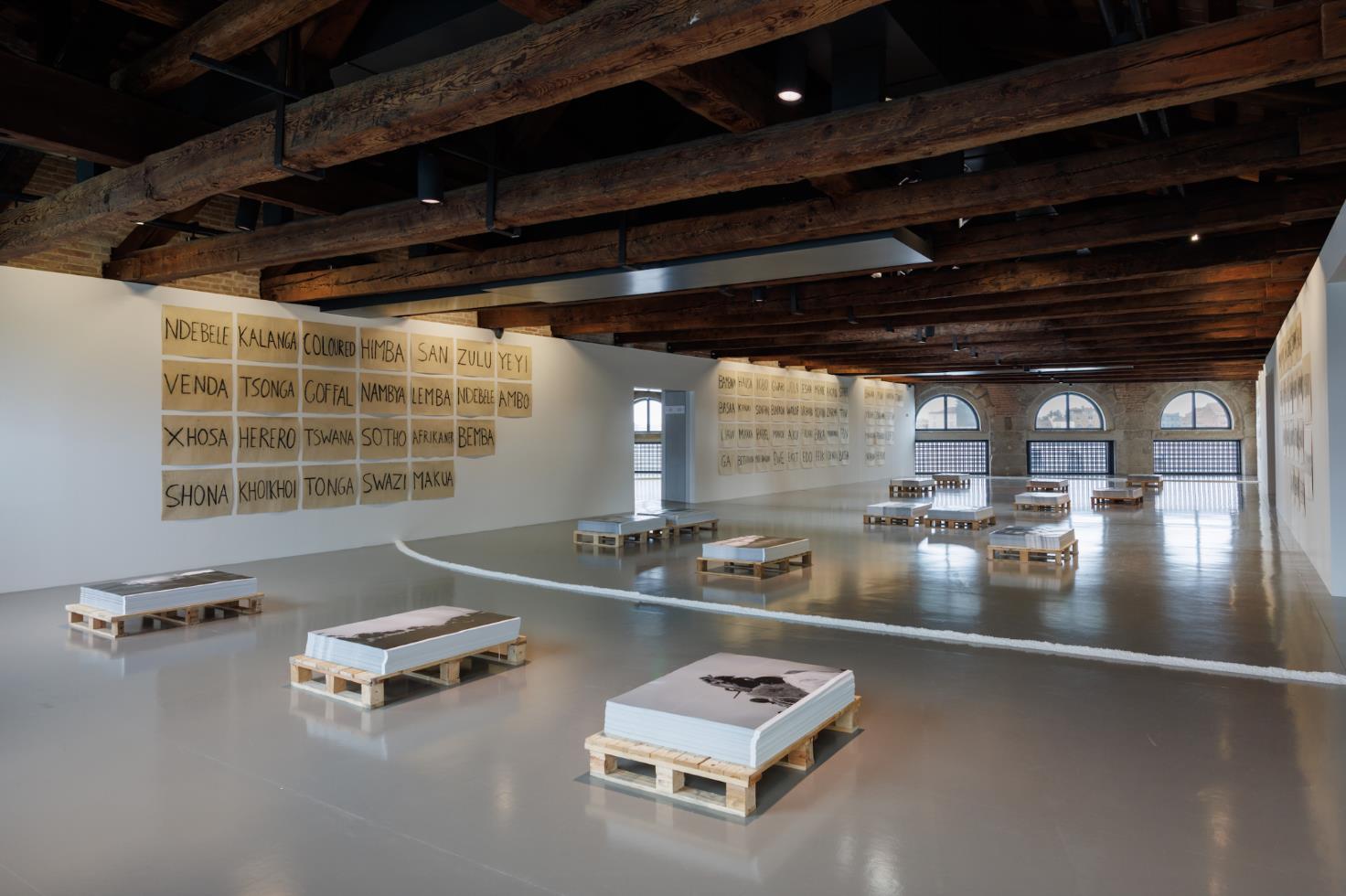
Installation view, “Paulo Nazareth. Algebra”, 2026, Punta della Dogana, Venice. Ph. Jacopo Salvi © Palazzo Grassi, Pinault Collection
Algebra: Reassembling What History Has Broken
The title of the exhibition offers a key to understanding its meaning.
Algebra derives from the Arabic term al-jabr, originally linked to the idea of reuniting or repairing something that has been broken. Nazareth uses this image as a metaphor for his practice: not to erase the wounds of history, but to bring their consequences back into view and attempt to reconnect what has been interrupted.
One of the most powerful installations runs through several rooms of Punta della Dogana in the form of a line of salt that traces the silhouette of a tumbeiro, one of the ships used by the Portuguese in the transatlantic slave trade. The location makes the work even more significant. Punta della Dogana was historically the place where goods arriving in Venice were registered and taxed. Nazareth brings the themes of trade and maritime routes back into this very space, but shifts the focus onto the people who, for centuries, were themselves treated as commodities. Salt also carries an ambiguous meaning: a precious substance and ancient trading material, but at the same time something capable both of preserving and corroding.
From Personal Archives to Forgotten Histories
Many works in Algebra begin with the artist’s own personal history and expand into much broader questions. In Amor de Mãe, for example, Nazareth uses Brazilian dishcloths embroidered by his mother in different languages, linking family memory, the role of women, and social violence.
In Cadernos de Africa and in works devoted to different regions of the African continent, travel becomes a way to redraw geographies that were defined for centuries through a European perspective.
The project Products of Genocide gathers commercial products that use names, stereotypes, or images referring to Indigenous and Black populations. Apparently ordinary objects thus become evidence of the way colonialism and racism can survive through language, advertising, and consumer culture.
Nazareth does not, however, construct a chronological narrative. The works belong to different periods and journeys and are freely combined, as if past and present formed part of the same territory to be crossed.
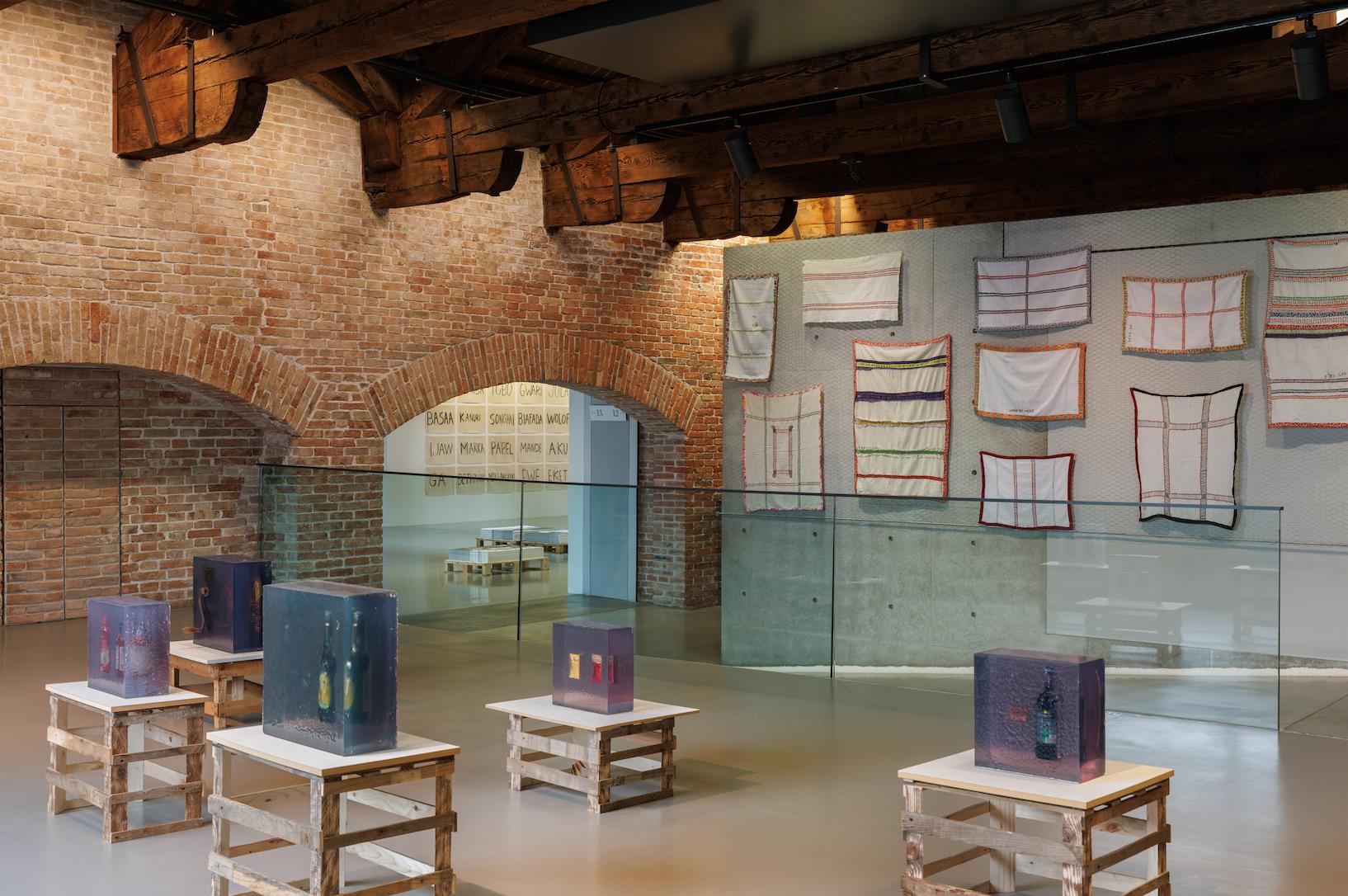
Installation view, “Paulo Nazareth. Algebra”, 2026, Punta della Dogana, Venice. Ph. Jacopo Salvi © Palazzo Grassi, Pinault Collection
Two Artists Looking at History from Another Perspective
It is precisely in the transition between Third Person and Algebra that the Punta della Dogana project becomes especially powerful.
Lorna Simpson works primarily with images; Paulo Nazareth with movement and experience. She enters archives and alters existing photographs and representations; he physically crosses geographies marked by colonial history.
Both, however, question the idea that history is something fixed and immutable.
Simpson’s large blue paintings, found photographs, female figures, and collages conceptually coexist with Nazareth’s maps, journeys, objects, and installations. Two different languages that ultimately lead to the same question: who decides which stories are remembered and which are allowed to be forgotten?
In a city like Venice, built for centuries around trade and routes connecting different cultures, this dialogue inevitably acquires a particular significance.
*All images on this blog are used for educational and critical purposes only. Credits and copyrights belong to their respective owners and authors. The gallery remains at the disposal of the rightsholders for any corrections, specific citations, or immediate removals upon request.

