The VENICE CRONORAMA
Rivus Altus in 10 years (2013-2023) by Max Farina
The first project, Rivus Altus, represents a true “attempt at exhaustion” of the most iconic and photographed panorama in Venice: the view from the Rialto Bridge. Over ten years, from 2013 to 2023, he has recorded every change in the landscape, focusing on the individual fragments that compose it. He “shatters the stereotype of Venice” and invites us to see the Grand Canal as through a magnifying lens, one that scrutinizes its smallest details.
Max Farina’s works are composed of a multitude of images—over 60,000 shots arranged like a puzzle—that form a perspective shaped by the unfolding of time: day and night, dawn and dusk…


La Fenice
Variation #14 – XL66 224,8×95,6 cm
Technique: Giclèe Fine Art Print, Transparent Plexiglas® + White Plexiglas® Floating fragments, Aluminum frame, 2024. Unique work.


Aqua Granda
Variation #12 – M78 177,7×68,4 cm / XS78 121,5×49,3 cm
Technique: Giclèe Fine Art Print, Transparent Plexiglas® + White Plexiglas® Floating fragments, Aluminum frame, 2024. Unique work.


Rosso Veneziano
Variation #17 – XL24 96×95,6 cm / M24 68,8×68,4 cm / XS24 49×49,3 cm
Technique: Giclèe Fine Art Print, Transparent Plexiglas® + White Plexiglas® Floating fragments, Aluminum frame, 2024. Unique work.


Serenissima
Variation #13 – XL24 96×95,6 cm / M24 68,8×68,4 cm / XS24 49×49,3 cm
Technique: Giclèe Fine Art Print, Transparent Plexiglas® + White Plexiglas® Floating fragments, Aluminum frame, 2024. Unique work.


Casanova
Variation #11 – XL24 96×95,6 cm / M24 68,8×68,4 cm / XS24 49×49,3 cm
Technique: Giclèe Fine Art Print, Transparent Plexiglas® + White Plexiglas® Floating fragments, Aluminum frame, 2024. Unique work.


Bucintoro
Variation #18 – M78 177,7×68,4 cm / XS78 121,5×49,3 cm
Technique: Giclèe Fine Art Print, Transparent Plexiglas® + White Plexiglas® Floating fragments, Aluminum frame, 2024. Unique work.


Arlecchino
Variation #15 – M78 177,7×68,4 cm / XS78 121,5×49,3 cm
Technique: Giclèe Fine Art Print, Transparent Plexiglas® + White Plexiglas® Floating fragments, Aluminum frame, 2024. Unique work.
The New York Cronorama
Brooklyn in 60 hours


Brooklyn
Variation #1 – N. 147 Single floating fragments 294x71x5 cm
Technique: Archival digital pigment print on Hahnemuhle paper. Aluminum frame, 2020. Unique work.
The New York Cronorama
Times Square in 60 hours
Extending this approach, Farina’s Cronorama series continues in New York, Times Square, known for its neon billboards and constant flow of people, this iconic location provides a stark contrast to the quiet contemplation of Venice. Farina’s observations of Times Square offer a fragmented, dynamic perspective, where the crowd and the overwhelming visual noise of advertisements collide, revealing the underlying rhythms of urban life in this bustling metropolis.

Times Square
Variation #04 – M104 177×84×5 cm
Technique: Giclèe Fine Art Print, Transparent Plexiglas® + White Plexiglas® Floating fragments, Aluminum frame, 2021. Unique work.

Times Square
Variation #05 – M104 177×84×5 cm
Technique: Giclèe Fine Art Print, Transparent Plexiglas® + White Plexiglas® Floating fragments, Aluminum frame, 2021. Unique work.
The Natural Cronorama
Lago Maggiore in 1 year

Lago Maggiore
Variation #02 – XS240 213×74×5 cm
Technique: Giclèe Fine Art Print, Transparent Plexiglas® + White Plexiglas® Floating fragments, Aluminum frame, 2021. Unique work.
The Milano Cronorama
La Madonnina in 120 hours

La Madonnina
Variation #03 – XS105 134.2×51.3×5 cm
Technique: Giclèe Fine Art Print, Transparent Plexiglas® + White Plexiglas® Floating fragments, Aluminum frame, 2021. Unique work.
The Cronorama Serie
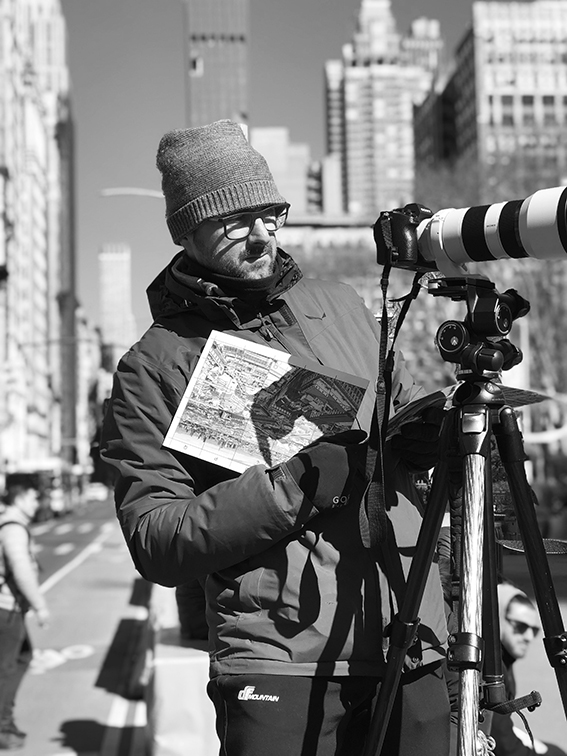
Over the years, Max Farina has developed a unique and original photographic practice, giving life to the Cronorami, projects of “visual exhaustion” based on a fragmented way of seeing. For more than ten years, through this singular approach and relentless visual observation sessions, he has studied cities while remaining fixed in the same vantage point. The Cronorami capture intricate details that reveal the hidden poetry within urban chaos. These time capsules preserve constantly evolving urban landscapes, offering a new perspective on the essence of each city. Over time, the work becomes an organic structure that continuously expands and evolves. Farina creates works in progress, adding new photographs over time, turning his practice into a continuous state of development. Inspired by Georges Perec’s An Attempt at Exhausting a Place in Paris (Paris, 1975), he lets the camera record what happens—even when nothing appears to happen. Max Farina’s works are composed of a multiplicity of images—over 10,000 shots arranged like a puzzle—forming a perspective shaped by the unfolding of time: day and night, sunrise and sunset…
Born in Milan in 1974, he graduated in architecture from the Polytechnic University of Milan. Since 1991, he has been dedicated to reportage photography, architecture, and documentation of the territory, collaborating both on commission and on personal artistic projects. Max Farina has always explored the visual impact of the passage of time on iconic, architectural, and landscape perspectives. He has adopted a fragmented vision, creating a series of photographic projects on “visual exhaustion” called “Cronorami,” a neologism he coined. For over 10 years, through this unique practice and numerous visual observations, he has studied cities that remain still in the same place. In 2016, he organized the first solo exhibition of Rivus Altus at the Don Orione Artigianelli space, at the Zattere, during the 15th Architecture Biennale, receiving significant recognition.